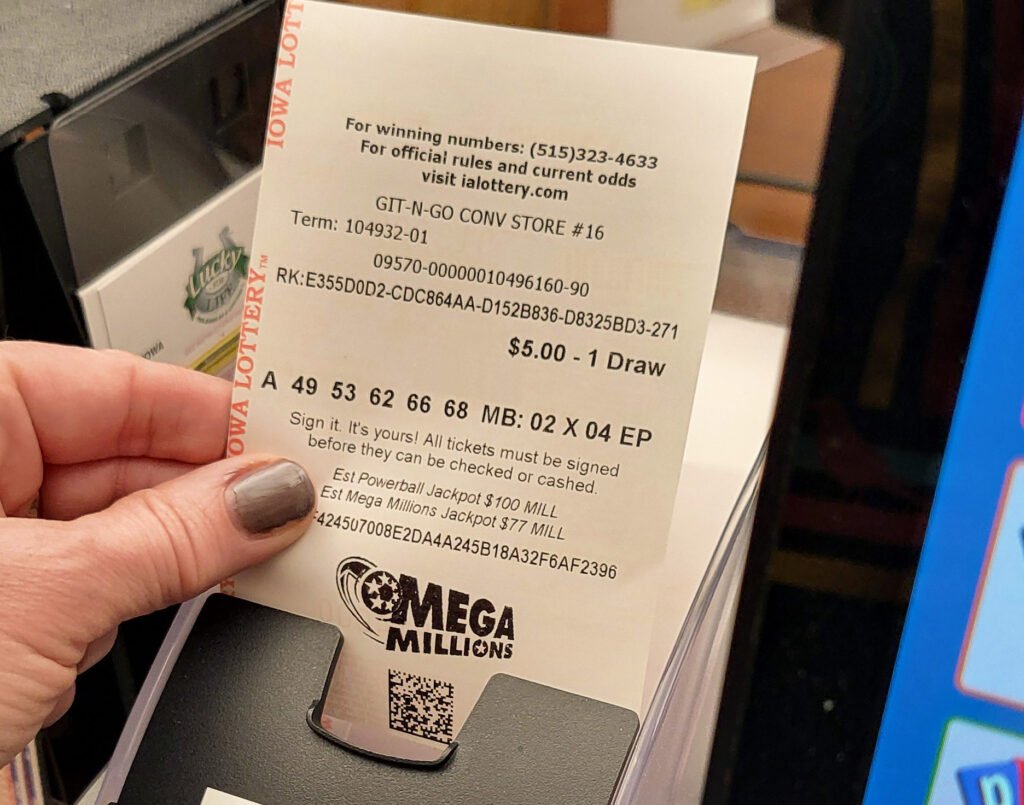
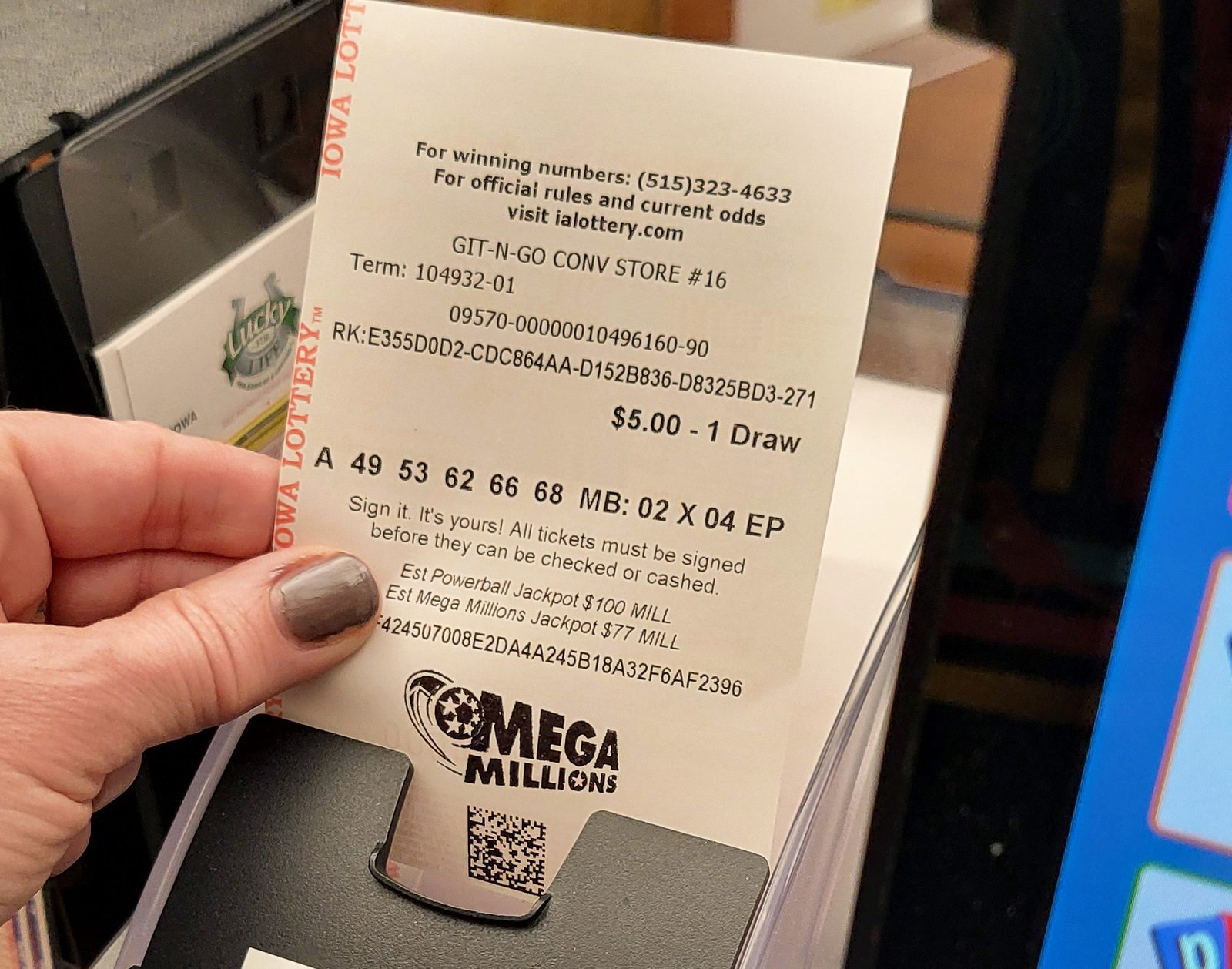
Different Mega Millions lines can have different multipliers because the current game assigns a multiplier to each play when it is purchased. The number printed beside one line belongs to that line. It is not a multiplier that you can move to another entry, and the largest multiplier anywhere on the receipt does not apply to the entire ticket.
Repeated multipliers are also possible. Seeing several 2X values, or two identical multipliers beside different selections, does not by itself indicate a printing error. The game has a limited set of multiplier values, and independent assignments can repeat.
The practical task is to keep three things connected: the line of selected numbers, that line’s match pattern, and that line’s printed multiplier. This guide explains that reading process with hypothetical examples. It covers the current format, not historical tickets from before the 2025 game change.
What changed in the current format
Mega Millions now includes a multiplier in each play, with possible values 2X, 3X, 4X, 5X and 10X. The official how-to-play page describes the multiplier as assigned at purchase and applicable to non-jackpot prizes. It is part of the current $5 play rather than a separate optional Megaplier purchase.
That distinction explains why older articles can be confusing. A guide written for the previous version may tell you to look for a single Megaplier result associated with the drawing. Applying that instruction to a current ticket can lead you to use the wrong multiplier.
When checking an older result, use the rules for its drawing date. When checking a current ticket, read the multiplier printed with the individual play. Do not combine an old prize chart, a new ticket price and a multiplier from a different format.
Our Mega Millions playing guide provides the broader game overview. Here the focus is the line-by-line relationship that matters once you already have a ticket.
Read the multiplier beside the winning line
Imagine a ticket with three entries. Line A has a 2X multiplier, line B has 5X, and line C has 3X. Suppose your manual check finds a qualifying non-jackpot match on line A only. You use line A’s 2X value, not the larger 5X printed beside line B.
If lines A and C both qualify, assess them separately. Each has its own match pattern and multiplier. You might therefore have two different payout calculations on the same receipt, even when the qualifying match pattern happens to be identical.
For a purely illustrative arithmetic example, suppose a hypothetical base award were $20. A qualifying line marked 2X would correspond to $40, while a qualifying line marked 3X would correspond to $60. These figures demonstrate multiplication only; they are not a substitute for the actual game’s prize chart.
The order of the calculation matters. First determine which line qualifies and at what tier. Then identify the prize basis used by the chart. Only then apply the multiplier if the displayed amount has not already included it.
Do not multiply an already multiplied prize
Some prize tables show base amounts. Others show a separate column for each multiplier and display the final amount in that column. If you choose the 5X column, the number shown there already reflects 5X. Multiplying it again would overstate the prize.
For example, a teaching chart might show a $10 base amount and a $50 amount under its 5X column. The reader should choose one route: $10 multiplied by five, or simply read $50 in the final column. Doing both produces $250, which is an arithmetic error caused by mixing chart formats.
Before using a table, read its column headings and footnotes. Words such as base, multiplier, prize with 3X, and final prize are not decorative. They tell you which calculation, if any, remains to be done.
Also check whether the table applies to the jurisdiction where the ticket was sold. The national Mega Millions page identifies California prizes as pari-mutuel and directs readers to the California Lottery for those amounts. A national fixed-prize example should not be treated as universal.
Why the same multiplier can repeat
A random assignment does not need to distribute all available values evenly across one ticket. If a system has five possible values, buying five plays does not imply receiving one of each. That would be sampling a fixed assortment rather than making random assignments under the game’s stated probabilities.
Consider a simplified teaching example with only two equally likely labels, A and B. Three independent assignments have eight possible sequences: AAA, AAB, ABA, ABB, BAA, BAB, BBA and BBB. Repeated labels occur in every sequence because there are more assignments than labels.
Even with five labels, repetitions are ordinary. The actual Mega Millions multiplier probabilities are not equal, so an equal-label example cannot predict its exact distribution. It merely demonstrates why “random” and “all different” are separate requirements.
The Iowa Lottery’s explanation expressly notes that multipliers on a multi-play ticket may differ, repeat, or all be the same. A receipt is not promised a balanced selection of the available values.
What the 10X odds do and do not mean
The published chance of a 10X multiplier is a probability for an assignment, not a schedule that guarantees one after a certain number of purchases. If a value has probability one in 32, that does not make the thirty-second play special after 31 other outcomes.
In a simplified model of 32 independent assignments with probability 1/32 each, the expected number of successes is one. But an expected count is an average across many repetitions of the whole experiment, not a guarantee for any particular group of 32.
The probability of no successes in that model is (31/32) raised to the 32nd power, about 36.2%. The probability of at least one is therefore about 63.8%. That example explains why an average count of one can coexist with a substantial chance of zero.
It is not a reason to keep buying plays. The multiplier concerns a payout condition on an entry that must still qualify for a prize. A large printed multiplier does not make the selected numbers more likely to match the drawing.
Multi-draw tickets need careful reading
A multi-draw purchase adds another dimension: one line can be entered in several drawings. Wisconsin’s official instructions say the multiplier attached to a multi-draw play remains with that play across its covered drawings. Maryland also explains how multipliers are retained on exchange tickets for remaining draws.
Do not assume a new multiplier will appear in the drawing results each time. Read the ticket’s covered dates and the multiplier associated with the line. For a ticket-specific question about exchanges or remaining entries, consult the selling lottery rather than generalizing another state’s procedures.
A checking worksheet can give each row a ticket reference, line letter, draw date, match pattern and multiplier. Repeating the same line across different eligible dates is a separate checking task from checking several lines for one date.
Keep the original or officially issued exchange ticket secure. A handwritten worksheet helps you track the process but does not replace the lottery’s evidence of an entry.
A worked checking exercise
Suppose a fictional three-line receipt shows A: 2X, B: 10X and C: 4X. Your number comparison produces A: qualifying tier Q, B: no qualifying match and C: qualifying tier R. A teaching prize table lists base values of $15 for Q and $25 for R.
The arithmetic is A: $15 multiplied by two, giving $30; B: no payout in this example; C: $25 multiplied by four, giving $100. The illustrative total is $130. The 10X on B does not affect A or C because B is a different play.
Now suppose the table instead lists Q at 2X as $30 and R at 4X as $100. The total remains $130. You read those final values directly. Multiplying them again would count the same multiplier twice.
The fictional tiers keep the exercise focused on reading, not memorizing prizes. For a real ticket, replace Q and R with the exact match categories and use the current official table for the selling jurisdiction.
Questions to resolve before claiming a result
Ask whether you have the correct drawing date, the correct line, and the correct special-ball match. A perfectly executed multiplication will still be wrong if the underlying match pattern came from another entry.
Next ask whether the amount you are reading is a base prize or a final multiplier-column value. Check the heading rather than relying on the biggest number visible on the page. Then confirm any jurisdiction-specific exception.
Finally, distinguish an estimated manual calculation from a validated prize. Keep the ticket and use the lottery’s authorized checking and claim process. A calculator, screenshot or blog example cannot establish that a physical ticket is payable.
If the receipt seems to have a missing or unreadable multiplier, contact the retailer or selling lottery with the original ticket. Do not guess the value from nearby entries or assume the highest available multiplier.
Keep multiplier size separate from winning probability
A 10X label can attract attention because it describes a larger potential non-jackpot payout. It does not identify a more promising set of winning numbers. The draw still determines whether that particular line meets a prize condition.
That distinction is helpful when comparing tickets with friends. One person may have a larger multiplier and another may have a qualifying match. Neither fact can be transferred between their entries, and neither predicts the next drawing.
Use our Mega Millions odds and prizes guide to connect match categories with the current structure. Use the results page to find the drawing you need, and then verify the ticket through the selling lottery.
The reliable habit is to follow one line from selection through match checking to its own multiplier. Keeping that chain intact prevents nearly every common multiplier-reading mistake.
Audit a payout calculation in reverse
After calculating a non-jackpot amount, work backward as a check. Identify the exact line that qualified, its match category and its printed multiplier. Then locate the corresponding row and column in the official table.
If your calculation used a base amount, dividing the result by the multiplier should return that base amount. If you read a final value directly from a multiplier column, no additional multiplication should have occurred. A reverse check can reveal the common error of applying the same multiplier twice.
For a fictional base award of $30 and a 4X value, the arithmetic result is $120. Dividing $120 by four returns $30. If a worksheet instead shows $480, ask whether someone read $120 from a final-prize column and multiplied it again.
Keep this arithmetic exercise separate from actual validation. It checks internal consistency, not entitlement to a prize. A correctly multiplied amount can still be attached to the wrong line, wrong drawing or wrong jurisdiction.
If you share a calculation with someone else, include the table heading and the line’s multiplier in the explanation. A bare dollar amount gives them no way to check your reasoning. A short trail from match category to multiplier to table value makes the result reviewable.
Browse all ticket-checking and probability guides in the Lottery Learning Library.
Sources and further reading
- Mega Millions official prizes and multiplier table
- Wisconsin Lottery: multiplier attached to each play
- Iowa Lottery: repeated multipliers
- Maryland Lottery: format change and exchange tickets
Reviewed October 18, 2026. Examples are illustrative unless identified otherwise. Winning Numbers Today is an independent information website; the selling lottery validates tickets and pays prizes.